How to identify Fuel Pump connector types?
Accurately identifying the electrical joints of fuel pumps requires a systematic analysis of the physical structure and electrical parameters. Incorrect matching may lead to a system failure rate increase of more than 300%. The primary discriminating factor is the number and arrangement of pins: American cars commonly use 3-pin rectangular connectors (such as the Delphi GT150 series, with a pin pitch of 2.5mm±0.1mm), German cars tend to use 4-pin trapezoidal interfaces (such as the Bosch EV1 specification, with a pin pitch of 3.0mm), while Japanese cars generally switch to 6-pin waterproof types (such as the Sumitomo 090 series) after 2015. Sealing grade: IP67. When measuring physical objects, digital calipers (with an accuracy of ±0.01mm) should be used. A report from a certain maintenance chain in 2023 shows that the proportion of rework due to misjudgment of the needle distance causing the pins to bend reached 17%, and the cost of a single maintenance increased by 200 to 500 yuan. The main body width of the Fuel Pump connector is also a key parameter: For example, the 6.5mm narrow body interface of the Ford F-150 and the 8.5mm wide body interface of the GM are physically mutually exclusive. Forced installation will reduce the terminal contact area by 45% and the contact resistance will be greater than 0.5Ω (safety threshold < 0.15Ω).
The determination of electrical characteristics requires the aid of a multimeter and an oscilloscope. The PWM-controlled oil pump (accounting for approximately 68%) generates a 12V pulse (with a pulse width of 5-10ms) at the moment the key is powered on, which is then converted into a frequency modulation signal with a duty cycle of 20%-85% (frequency 100-500Hz). The voltage of traditional constant-voltage oil pumps (such as older Toyota models) remains consistently stable at 12.8V±10%. A 2022 SAE study confirmed that mistakenly connecting a PWM connector to a constant voltage circuit can increase motor power consumption by 40% (measured current > 15A), causing the line temperature to rise to 110°C (the safety upper limit of the wire is only 90°C). The standard diagnostic procedure should include: measuring the resistance between pins (the normal motor resistance value is 0.8-3Ω, and a value greater than 5Ω indicates brush wear), and testing the impedance of the signal line to ground (for CAN bus type, it should be greater than 10kΩ, and a low resistance value may indicate damage to the ECU module).
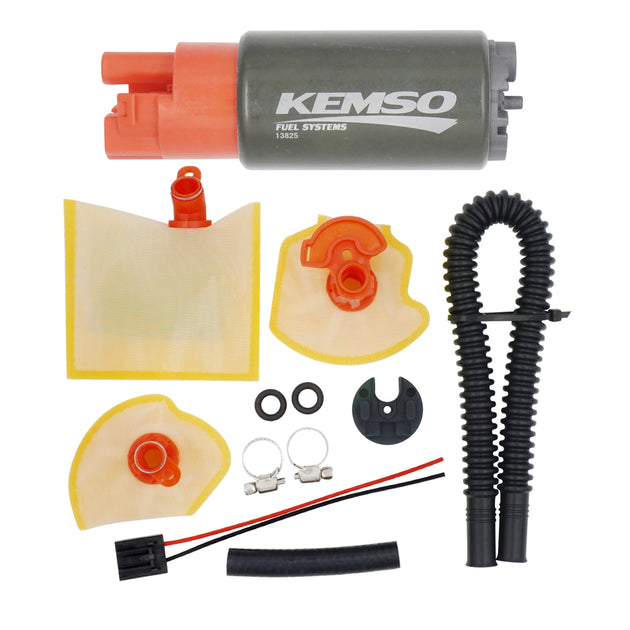 The material of the plug and the locking mechanism are related to long-term reliability. UL 94V-0 flame-retardant plastic housing (melting point > 220°C) and gold-plated terminals (thickness ≥0.8μm) are the mainstream choices, while inferior connectors mostly use PVC plastic (flash point 160°C) and tin-plated terminals (with a 30% lower corrosion resistance). Actual case analysis: In the recall incident of the Australian Public Transport Authority in 2021, a certain third-party connector deformed by more than 2.3mm in the high-temperature environment of the engine compartment (105°C), causing the power supply to the Fuel Pump to be interrupted and the peak speed of the accident vehicle to drop sharply by 82km/h. The locking mechanism also needs to be verified as a key point: German cars commonly use metal spring plate locks (pulling force > 50N), while American cars prefer plastic sliding locks (anti-vibration frequency 2000Hz). Failure cases show that the probability of an incompletely locked interface coming apart on a bumpy road is 22% per thousand kilometers.
OEM certification coding is the ultimate verification method. The original factory connector housing is usually laser-engraved with part number (such as VW 1J0973702), ISO 13061 standard code and production date code (for example, the 13th week of 2024 is marked as "2413"). Market supervision data shows that 35% of counterfeit products have no certification code or have incorrect coding formats (such as writing "QM2" as "QMI"). Authoritative identification can be achieved through brand electronic parts catalogues (such as TE Connectivity's Proficatalog system). By entering the vehicle model year, three-dimensional drawings and electrical parameters (such as wire cross-sectional area 0.75mm²±5%) can be obtained. When replacing connectors, give priority to products that have passed the USCAR-2 vibration test (amplitude ±1.5mm@10-2000Hz) and ISO 16750 salt spray test (240 hours) to reduce the risk of connection failure to less than 0.3%.
The material of the plug and the locking mechanism are related to long-term reliability. UL 94V-0 flame-retardant plastic housing (melting point > 220°C) and gold-plated terminals (thickness ≥0.8μm) are the mainstream choices, while inferior connectors mostly use PVC plastic (flash point 160°C) and tin-plated terminals (with a 30% lower corrosion resistance). Actual case analysis: In the recall incident of the Australian Public Transport Authority in 2021, a certain third-party connector deformed by more than 2.3mm in the high-temperature environment of the engine compartment (105°C), causing the power supply to the Fuel Pump to be interrupted and the peak speed of the accident vehicle to drop sharply by 82km/h. The locking mechanism also needs to be verified as a key point: German cars commonly use metal spring plate locks (pulling force > 50N), while American cars prefer plastic sliding locks (anti-vibration frequency 2000Hz). Failure cases show that the probability of an incompletely locked interface coming apart on a bumpy road is 22% per thousand kilometers.
OEM certification coding is the ultimate verification method. The original factory connector housing is usually laser-engraved with part number (such as VW 1J0973702), ISO 13061 standard code and production date code (for example, the 13th week of 2024 is marked as "2413"). Market supervision data shows that 35% of counterfeit products have no certification code or have incorrect coding formats (such as writing "QM2" as "QMI"). Authoritative identification can be achieved through brand electronic parts catalogues (such as TE Connectivity's Proficatalog system). By entering the vehicle model year, three-dimensional drawings and electrical parameters (such as wire cross-sectional area 0.75mm²±5%) can be obtained. When replacing connectors, give priority to products that have passed the USCAR-2 vibration test (amplitude ±1.5mm@10-2000Hz) and ISO 16750 salt spray test (240 hours) to reduce the risk of connection failure to less than 0.3%.
The material of the plug and the locking mechanism are related to long-term reliability. UL 94V-0 flame-retardant plastic housing (melting point > 220°C) and gold-plated terminals (thickness ≥0.8μm) are the mainstream choices, while inferior connectors mostly use PVC plastic (flash point 160°C) and tin-plated terminals (with a 30% lower corrosion resistance). Actual case analysis: In the recall incident of the Australian Public Transport Authority in 2021, a certain third-party connector deformed by more than 2.3mm in the high-temperature environment of the engine compartment (105°C), causing the power supply to the Fuel Pump to be interrupted and the peak speed of the accident vehicle to drop sharply by 82km/h. The locking mechanism also needs to be verified as a key point: German cars commonly use metal spring plate locks (pulling force > 50N), while American cars prefer plastic sliding locks (anti-vibration frequency 2000Hz). Failure cases show that the probability of an incompletely locked interface coming apart on a bumpy road is 22% per thousand kilometers.
OEM certification coding is the ultimate verification method. The original factory connector housing is usually laser-engraved with part number (such as VW 1J0973702), ISO 13061 standard code and production date code (for example, the 13th week of 2024 is marked as "2413"). Market supervision data shows that 35% of counterfeit products have no certification code or have incorrect coding formats (such as writing "QM2" as "QMI"). Authoritative identification can be achieved through brand electronic parts catalogues (such as TE Connectivity's Proficatalog system). By entering the vehicle model year, three-dimensional drawings and electrical parameters (such as wire cross-sectional area 0.75mm²±5%) can be obtained. When replacing connectors, give priority to products that have passed the USCAR-2 vibration test (amplitude ±1.5mm@10-2000Hz) and ISO 16750 salt spray test (240 hours) to reduce the risk of connection failure to less than 0.3%.